The Hidden Cost Multiplier in Every Conveyor Failure
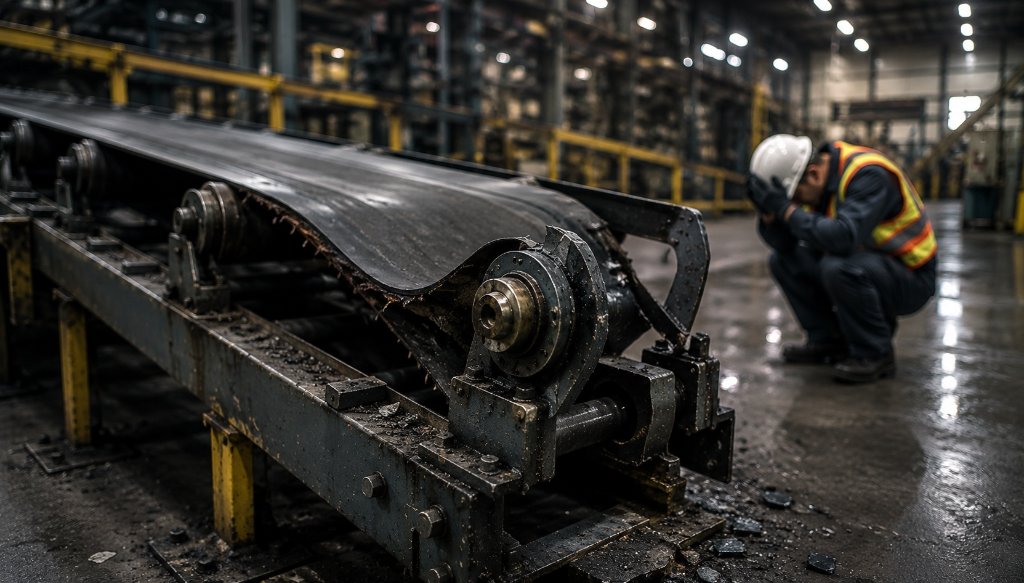
When a conveyor system stops unexpectedly, the immediate response typically focuses on diagnosis and repair: identify the failed component, source a replacement, and restore operation as quickly as possible. This response is understandable, but it captures only a fraction of the true cost of the event.
Conveyor failures generate financial losses across multiple operational dimensions simultaneously. Understanding the full scope of these costs — including the substantial hidden components that rarely appear in maintenance budgets — is essential for building a compelling case for reliability investment and for accurately calculating the return on predictive monitoring technology.
Direct Maintenance Costs: The Visible Portion
The costs most readily visible after a conveyor failure include replacement parts, maintenance labor, and any emergency procurement premiums. For a typical industrial conveyor system, these direct costs vary widely depending on the specific failure mode:
- Idler roller replacement: relatively low individual cost, but high frequency and potential cascade effects
- Belt damage or replacement: significant material cost, particularly for specialty belting
- Bearing and gearbox failures: moderate to high parts cost with significant labor requirements
- Drive motor failures: high parts and labor cost with potential secondary damage
- Structural damage from secondary failure: highly variable, potentially catastrophic cost
Emergency maintenance premiums — overtime labor rates, expedited shipping for parts, and after-hours contractor costs — typically add 40 to 100 percent to the base cost of an unplanned repair compared to the same work performed as a scheduled intervention.
Production Impact: Where the Real Costs Accumulate
For most industrial facilities, the direct maintenance cost of a conveyor failure is substantially smaller than the value of production lost during the downtime event. This ratio depends on the facility's throughput capacity, product value, and the criticality of the affected conveyor in the production process.
Throughput Loss
Every hour a primary conveyor is out of service represents a direct reduction in productive output. In high-throughput environments — automotive manufacturing, food processing, distribution centers, mining operations — conveyor downtime can translate to tens or hundreds of thousands of dollars per hour in lost production value.
Upstream and Downstream Cascade Effects
Conveyor systems rarely operate in isolation. A failure in one section of a material handling system often forces shutdowns in upstream and downstream operations as buffers fill or empty. In highly integrated production environments, a single conveyor failure can halt an entire line or facility section, multiplying the production impact well beyond the capacity of the failed equipment alone.
Labor Idle Time
Production personnel whose work depends on the failed conveyor cannot continue productive work during the downtime event. Depending on facility size and process integration, a significant conveyor failure can idle dozens or hundreds of workers while maintenance teams work to restore operation.
Quality and Customer Impact
Conveyor failures that affect time-sensitive materials — perishable food products, temperature-sensitive chemicals, just-in-time manufacturing components — can generate quality losses that extend well beyond the production downtime itself. Products in process at the time of failure may be scrapped. Customer deliveries may be delayed, triggering contractual penalties or damaging relationships with key accounts.
In regulated industries, unexpected process interruptions may require additional documentation, quality holds, and regulatory reporting — adding administrative burden and potential compliance risk to the financial impact.
Acceleration of Secondary Failures
Conveyor failures rarely affect only the failed component. The mechanical event that causes a bearing or idler to fail often subjects adjacent components to abnormal stress, accelerating their degradation. Belt damage from a seized roller, for example, may not be immediately apparent but can significantly shorten belt service life — creating a future failure that is directly traceable to the original event.
This secondary failure cascade is particularly common in conveyor systems because the continuous nature of the equipment means that any mechanical irregularity is subjected to rapid cycling. A developing vibration anomaly that would take months to progress in a pump operating at moderate load can accelerate dramatically in a conveyor running millions of cycles per day.
How Predictive Monitoring Changes the Economics
Wireless condition monitoring deployed on conveyor drive components — motors, gearboxes, head and tail pulleys, and take-up systems — enables maintenance teams to detect developing failure conditions before they produce operational impact. The economic benefit of this early detection is not limited to avoided repair costs; it encompasses the full avoided cost of the production event that would otherwise have occurred.
When maintenance teams receive early warning of a developing bearing anomaly and schedule a replacement during a planned shutdown window, they avoid:
- All unplanned production downtime
- Emergency labor and parts procurement premiums
- Secondary and cascade damage
- Customer delivery disruptions
- Quality losses from in-process materials
The return on investment calculation for conveyor monitoring is straightforward: the cost of monitoring technology and deployment is compared against the probability-weighted avoided cost of unplanned failures. For facilities with high-throughput conveyor operations and historically poor conveyor reliability, this calculation typically demonstrates payback periods measured in months, not years.
Building a Conveyor Reliability Program
Effective conveyor reliability management requires combining continuous monitoring technology with structured maintenance processes. Monitoring data alone does not prevent failures — it provides the information needed to make better maintenance decisions. Organizations that extract the greatest value from predictive monitoring invest in building the workflows and response protocols that translate sensor data into maintenance actions before failures occur.
The starting point for most facilities is identifying the conveyor assets whose failure would create the greatest operational impact, deploying monitoring on those assets first, and using the resulting data to build familiarity with the technology and establish baseline operating patterns before expanding coverage.
For a comprehensive operational guide covering conveyor monitoring strategies, failure point reference, inspection frameworks, and industry-specific reliability considerations, see: Conveyor Monitoring & Reliability — Operational Guide.